
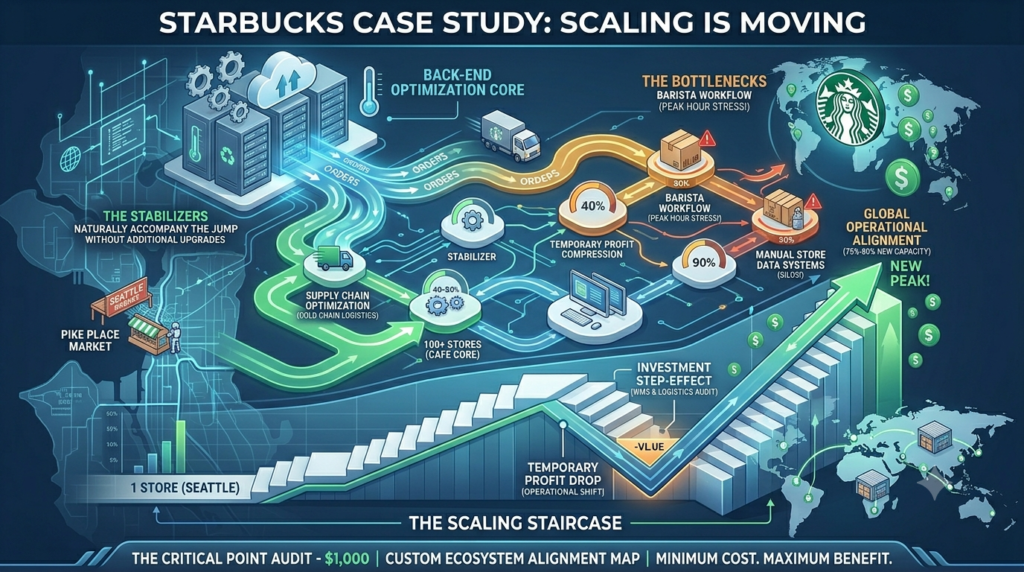
In the corporate architecture of high-growth business, there is a dangerous misconception that scaling means reaching a static, stable plateau. Many founders and executives design their systems to reach a «perfect size» where they can finally stop, rest, and collect margins.
That is a structural illusion. Scaling is not a destination; scaling is moving.
True scale is defined by velocity, transaction density, and continuous operational momentum. When an ecosystem is in constant motion, it creates an unpredictable friction that releases entirely new, massive revenue opportunities—opportunities that no business plan could have ever anticipated during the initial design phase.
The ultimate historical proof of this architectural law is Starbucks and its legendary, accidental transformation into an interest-free multibillion-dollar bank.
[ CONTINUOUS TRANSACTIONAL MOVEMENT ]
                 │
                 ▼
     [ OPERATIONAL FRICTION ]
                 │
                 ▼
[ NEW, UNANTICIPATED FINANCIAL ECOSYSTEMS ] (The Starbucks Float)
1. The Operational Law of Velocity: Why Scale Requires Drift
When you optimize your front-end customer acquisition and build a clean, decoupled back-end infrastructure, you are not building a fortress; you are building an engine.
If an engine stops moving, it stalls. If your transactional flow slows down, your structural costs catch up to your margins, dragging you back down the scaling staircase.
When Starbucks began expanding its footprint globally, leadership didn’t just focus on the physical asset density of their coffee shops. They focused on reducing transactional latency. They realized that the physical exchange of cash or credit cards at the point of sale (POS) was a massive friction point that limited the operational capacity of their baristas during peak hours.
To solve this front-end bottleneck, they introduced a basic operational tool: The Starbucks Card and, subsequently, the mobile application.
The original strategic objective was simple:
- Speed up the queue.
- Increase customer retention through loyalty loops.
- Reduce transaction processing fees.
They designed a system to keep the customer moving. But because the ecosystem was moving at such extreme velocity and scale, something fascinating happened in the background data layers.
2. The Accidental Billion-Dollar Bank: The Power of «The Float»
By forcing or incentivizing millions of global users to pre-load money onto their digital cards to purchase coffee faster, Starbucks inadvertently stepped into a completely different business vertical: Banking.
When a customer uploads $50 to their Starbucks app, they are not buying coffee yet. They are giving Starbucks a 0% interest loan.
Today, Starbucks holds more than $1.6 billion in unspent balances across its digital ecosystem.
To put this structural reality into perspective:
- Starbucks holds more cash deposits than approximately 85% of all commercial banks in the United States.
- Unlike a traditional commercial bank, which must hold regulatory reserves, pay interest to depositors, and comply with strict financial risk restrictions, Starbucks can use this $1.6 billion with absolute freedom.
- They can invest this cash into short-term high-yield bonds, deploy it to fund massive capital expenditures, or use it to optimize their supply chain—all using free money provided by their own customers.
Furthermore, a significant percentage of those digital balances are lost, forgotten, or left unredeemed for years. This phenomenon—known in corporate finance as breakage—directly transfers tens of millions of dollars of pure, 100% margin straight into Starbucks’ annual net profit.
They did not sit down in a boardroom in Seattle twenty years ago and say: «Let’s build a financial institution that sells coffee as a front-end lead magnet.» They simply focused on scaling the movement of transactions, and the immense velocity of that movement opened a multi-billion-dollar financial door.
3. The Executive Lesson: Opportunities are Born from Momentum
This is the ultimate lesson for any entrepreneur or strategic consultant managing a scaling roadmap. You cannot map out every single monetization angle of your future corporate tier from day one. Your primary responsibility is to create orderly momentum.
When your business systems are executing at a high transaction density, the operational drift will naturally reveal hidden assets within your infrastructure:
- In eCommerce: A massive surge in shipping movement might reveal that your automated returns data is valuable enough to be packaged as a secondary B2B analytics product.
- In Agencies: High-volume workflow automation might generate internal operational frameworks (SOP packs) that can be spun off into self-service SaaS tools.
- In Systems Architecture: High data throughput allows you to optimize cash flow cycles and negotiation terms with suppliers due to predictable forecasting.
If you don’t scale the movement, your business remains static, and static systems do not generate luck. In contrast, when your structure reaches that critical 75% to 80% working capacity threshold, the sheer volume of touchpoints creates a fertile ground for unexpected, high-margin revenue anomalies.
Conclusion: Keep the Engine Running
Do not wait for a perfect market overview to expand your operational boundaries. Focus on alignment, eliminate the manual bottlenecks that slow down your transaction flows, and get your ecosystem moving.
Scale is a dynamic state. Build the engine, push the front-end velocity, stabilize the back-end infrastructure, and prepare your organization to capture the massive, unpredictable financial opportunities that only present themselves when a company is moving at maximum speed.