
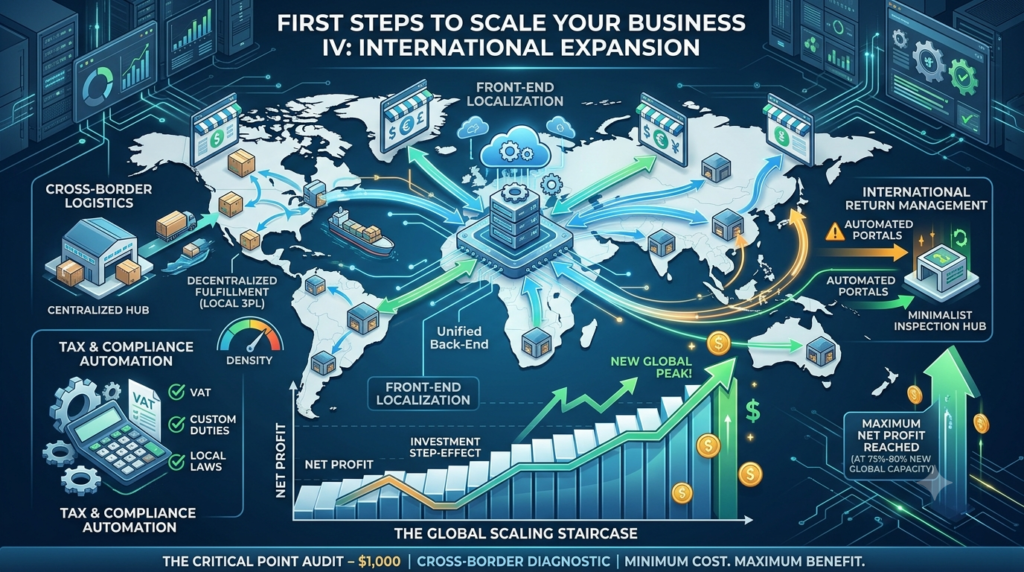
Following our analysis of vertical product expansion, we arrive at the ultimate frontier of growth: geographical and international scaling. Taking your business across borders is the definitive test for a decoupled architecture and automated operations.
When moving from a local market to an international footprint, the complexity doesn’t just add up—it multiplies. Here is the operational checklist to ensure your infrastructure accompanies your global leap naturally, keeping your cost structure under control.
1. Front-End Localization vs. Global Standardization
Just as we analyzed in symmetric expansions, your acquisition engine must adapt without breaking your core identity. International scaling requires localized front-end experiences backed by a single, unified backend.
- The Multi-Currency & Language Layer: Utilizing platforms like Shopify Plus allows you to deploy localized storefronts. Your copy, pricing strategies, and high-ticket bundles must match the local cultural nuances and purchasing power of the target country.
- The Data Test: Ensure your analytics, pixel tracking, and customer databases sync flawlessly into your central ERP. If an international market requires separate, manual data processing, your administrative workflows will experience severe latency.
2. Cross-Border Logistics and Inventory Density
Deploying inventory internationally is a balancing act of physical capacity and delivery speed. Leadership must decide between two primary fulfillment models:
- Centralized Hub (Cross-Border Shipping): Shipping everything from your main warehouse. This keeps your inventory asset density under control and utilizes your existing layout naturally, but it introduces higher shipping costs and longer delivery windows for the end consumer.
- Decentralized Fulfillment (Local 3PL): Positioning stock directly in the target country. This offers domestic-level delivery times and higher conversion rates, but it forces your systems to manage multi-warehouse inventory tracking and increases cash flow lockup in secondary stock pools.
3. The International Return Management Echo
If your domestic return process is manual, international returns will completely drain your net margins. Cross-border reverse logistics involve custom duties, varied transit times, and complex routing.
- The Action: Implement automated international return portals that generate pre-paid localized labels and automatically route items to the nearest inspection hub or liquidate them on the spot if the return shipping cost exceeds the product’s net margin value.
4. Fiscal, Legal, and Compliance Aligned Frameworks
Every new border introduces a new legal and tax matrix. Scaling internationally means your financial systems must automatically handle multi-state VAT, custom duties, and local consumer protection laws without requiring a massive expansion of your accounting headcount.
The Global Scaling Blueprint
International expansion is the highest step on the Scaling Staircase. It initially demands heavy operational investment and temporary margin compression as you establish local compliance and logistics tracks. However, once your multi-currency, multi-warehouse structure reaches 75% to 80% operational capacity, it unlocks a massive, highly diversified revenue engine that protects your business from local market fluctuations and drives your net profit to a brand-new global peak.