
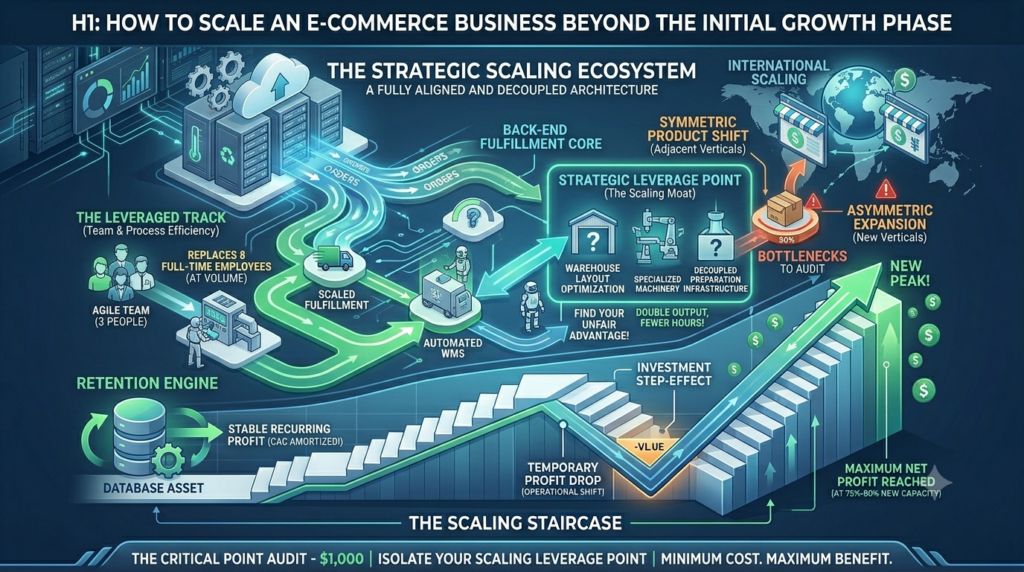
When an e-commerce brand moves past its early traction, scaling becomes less about raw hustle and more about systemic engineering. You cannot bridge the gap to high-volume operations by simply doubling your ad spend; you must rebuild the structural foundation of your entire ecosystem.
1. The Scaling Staircase: Managing the Investment Step-Effect
A critical concept every operator must internalize before deploying growth capital is that scaling requires an intentional, temporary squeeze on net margins. When your data reveals that you need to optimize front-end acquisition and back-end fulfillment simultaneously, you enter an infrastructure shift.
Net Profit
  ▲
  │          (New Peak!)
  │             ┌───► [New Structure at 75%-80% Capacity]
  │             │
  │   ┌─────────┘ ◄─── The "Investment Step" (Temporary Margin Drop)
  │   │
  ────┴──────────────────────────────────► Time
Upgrading operational sections to handle a front-end spike demands significant resource allocation, meaning your net profit will immediately decrease in the short term. This temporary dip is the structural cost of building your next corporate tier. This new setup will only generate a higher net profit than your previous baseline once the newly aligned infrastructure reaches 75% to 80% of its working capacity.
2. Retention as a Scaled Profit Engine
In the early stages of an e-commerce business, growth is heavily dependent on the constant friction of cold acquisition. However, once your business moves past initial traction and hits a critical volume, customer retention shifts from a metric you monitor to a core pillar of your scaling strategy.
At scale, the compound effect of a loyal database transforms retention into a highly predictable, stable source of recurring net profit. You are no longer just building loops for engagement; you are unlocking structural margin. Because the front-end acquisition cost (CAC) for these repeat buyers was amortized long ago, the revenue generated from retention behaves as a predictable, high-margin asset that stabilizes the entire business model against external market fluctuations.
3. Team Leverage and Process Optimization
True scaling is fundamentally a mathematical optimization of your teams and workflows. It is the art of breaking linear dependencies—ensuring that a 100% increase in order volume does not require a 100% increase in payroll or headcount.
Consider a practical operational shift at high volume: An agile team of just three people, equipped with the right machinery and an automated system, successfully executing the daily workload that previously required eight full-time employees.
This level of structural leverage is mathematically impossible in small-scale setups because low-volume operations cannot absorb or justify the fixed overhead of advanced infrastructure. It is only when your transaction density crosses a high-volume threshold that deploying advanced systems instantly converts hidden operational friction into pure bottom-line efficiency.
4. Identifying Your Strategic Leverage Point (The Scaling Moat)
To achieve this asymmetric leverage, leadership must identify the exact Strategic Leverage Point within their ecosystem. This is the single, specific operational node that acts as your unfair competitive advantage when the business accelerates.
You must audit your layout and ask: Where is our unique scaling moat?
- The Machinery: Is it a specialized piece of hardware that exponentially speeds up manufacturing or custom assembly?
- The Warehouse Layout: Is it a highly optimized physical routing design that minimizes pick-and-pack travel time?
- The Order Preparation Infrastructure: Is it a decoupled software integration that automatically bundles, labels, and routes shipments based on real-time carrier capacity?
Finding this bottleneck-breaker is what allows your business to double production and dispatch capacity while simultaneously reducing manual labor hours and execution time.
5. Front-End Velocity and the Symmetric Product Shift
To drive the volume necessary to fill that newly engineered capacity without skyrocketing your marketing costs, your front-end strategies must focus on maximizing Customer Lifetime Value (LTV) and Average Order Value (AOV).
- Symmetric Vertical Expansion: Introduce adjacent product verticals that lock seamlessly into your existing infrastructure.
- The Ecosystem Fit: For example, expanding from a core line of premium pet food into toys and specialized grooming products allows you to market to the exact same database.
- Administrative Alignment: The acquisition infrastructure, data layers, and warehouse workflows remain identical, driving high-margin revenue with zero added operational friction.
6. The Choice of Horizon: Asymmetric Expansion
Alternatively, scaling can be achieved through an asymmetric expansion—entering a completely unrelated vertical to capture net-new customer segments.
- The Strategic Challenge: This path requires building a brand-new front-end acquisition engine from scratch, meaning ad creative, messaging, and audience pools cannot be recycled.
- The Infrastructure Test: While marketing is built anew, your back-end operational engine faces a massive test. The new vertical must still rely on your core systems (accounting software, main logistics partnerships) to maintain linear cost growth. If it requires completely separate infrastructure, you lose all structural leverage.
| Metric / Dimension | Symmetric Expansion (Adjacent) | Asymmetric Expansion (Unrelated) |
| Primary Focus | Maximizing existing Customer LTV. | Net-new Customer Acquisition. |
| Front-End Cost | Minimum (Uses existing ad accounts & data). | Maximum (Requires separate funnels & testing). |
| Back-End Impact | Low friction; uses current layouts and workflows. | High risk of data silo creation or fulfillment friction. |
7. International Scaling: The Ultimate Cross-Border Frontier
Taking your business across geographical borders is the definitive test for a decoupled architecture. To prevent international scaling from dragging you backward down the staircase, your backend must remain unified while the front-end localizes:
- Front-End Localization: Deploy localized storefronts with multi-currency checkouts, localized copy, and native payment methods, while ensuring all sales data syncs into a single central ERP.
- Fulfillment Optimization: Choose between a Centralized Hub (shipping internationally from your main warehouse to control inventory density) or Decentralized 3PL Nodes (positioning stock locally to offer faster domestic delivery times at the cost of locked cash flow).
- Reverse Logistics Automation: Implement automated international return portals. If your cross-border return processes are manual, shipping costs, custom duties, and transit latencies will quickly destroy your global net margins.
8. Scaling is Moving: Embracing Transactional Drift
Ultimately, you must recognize that scale is a dynamic state of velocity. When an ecosystem is in constant motion, the sheer speed and density of transactions create unpredictable operational friction that releases entirely new, massive revenue opportunities.
By focusing relentlessly on reducing transactional latency—such as optimizing checkout speed, automating workflows, and removing manual backend bottlenecks—the resulting momentum naturally reveals hidden corporate assets. Build the engine, push the velocity, stabilize the infrastructure, and allow the continuous movement of your system to unlock your next peak of profitability.