
In the U.S. market, scaling is a systems engineering challenge. Once a brand moves past initial growth, the infrastructure must handle high-velocity data and execution. If the platform isn’t built for this, increased sales will lead to operational friction and margin erosion.
To scale efficiently, the platform infrastructure must act as a unified engine across these three critical layers:
1. The Execution Layer: Information + Action with Shopify Plus
At the Enterprise level in the USA, a platform is a Command & Control center. Shopify Plus is the standard for brands aiming for the $200K+ monthly threshold due to its native ability to merge data with execution.
- Integrated Intelligence: It’s about the seamless flow of information. With Shopify Flow and custom scripts, the platform executes complex business logic in real-time, automating decisions that would otherwise require manual intervention.
- Global Execution: Scaling in the U.S. requires managing regional complexities instantly. An expert platform handles taxes, localization, and 3PL (Third-Party Logistics) logic, ensuring that expansion doesn’t increase fixed operational costs.
2. The Resilience Layer: The 10,000 Concurrent User Stress Test
True scaling requires invisible infrastructure. In a market where a 100ms delay in page load can drop conversion by 7%, technical resilience is a mandatory financial requirement for growth.
- Elastic Infrastructure: The platform must handle the «Success Spike.» Maintaining 10,000 concurrent visitors without lag is the baseline for market leaders during Black Friday or viral campaigns.
- Performance as a Moat: If the platform collapses under pressure, the Customer Acquisition Cost (CAC) effectively doubles. A scalable platform is built for zero-downtime, ensuring every dollar spent on traffic is processed efficiently.
3. The Scaling Paradox: Navigating the Profit Valleys
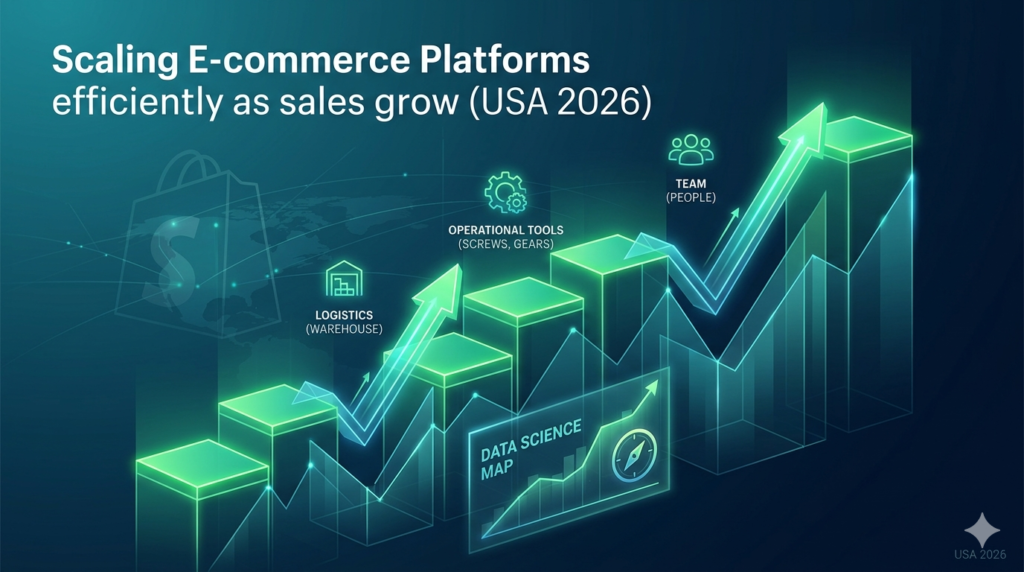
The most critical factor to understand is that scaling is not linear. Growth doesn’t mean winning more every day; it means knowing how to jump from one step of the ladder to the next.
- The Profit Step-Down: Every «jump» to a new level requires a massive injection of resources: more warehouse space (logistics), more advanced tools (operability), and more specialized talent. At this precise moment, net profit drops. You are investing in the next level of capacity before the revenue catches up.
- The «Profit Valley»: Between these steps, there is a valley where you spend more but haven’t yet reached the volume to stabilize the margin. This is where most e-commerce brands fail: they lack the «sprint» capability to cross this valley quickly.
- Data-Driven Stabilization: Scaling is only feasible when your growth system contemplates how to pass to the next point and stabilize the business. Every niche has different needs, but with the right data and tools, you can predict these «valleys» and act with fluid precision.
By knowing exactly where you need to go, the transition becomes a calculated maneuver rather than a gamble. Scaling isn’t about selling more—it’s about engineering the jump to the next level of profitability.
«Scaling efficiently means leveraging Data Science to know exactly when net profit will stabilize again.»