
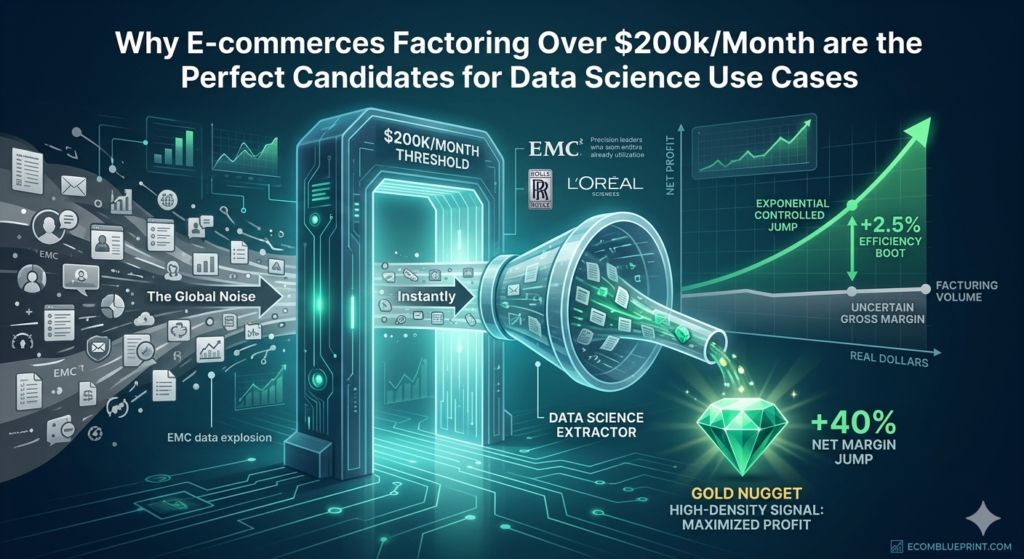
If your e-commerce brand has crossed the $200,000 monthly revenue mark, you are no longer in a growth phase; you are in an efficiency crisis. At this scale, every 1% of operational inefficiency is a $2,000 monthly leak. While generic 2024 guides focus on «knowing your customer,» at $200K/month, Data Science is the essential tool to translate massive volume into real net profit jumps.
The «$200K Threshold»: Why Volume Changes the Game
The consensus in current market analysis identifies five core reasons why $200K/month is the «Point of No Return» for implementing Data Science:
- High Data Velocity and Volume: Businesses doing >$200k/month generate significant daily transaction logs. This volume provides enough data points to train AI models for demand forecasting and behavior prediction without over-fitting.
- Maximum Impact on ROI: For a $50k/month store, a 5% increase in efficiency is marginal. For a $200k+ store, that same 5% optimization is a substantial increase in net profit.
- Solving Complex Operational Bottlenecks: As revenue grows, complexity increases. Data Science helps predict demand to solve «cash tied up in stock» scenarios and prevents lost sales from stockouts.
- Advanced Customer Experience (Retention): At this level, you can no longer offer personalized service manually. AI-driven CLV (Customer Lifetime Value) prediction can identify high-value customers early, increasing LTV by up to 40%.
- Advanced Fraud Prevention: High-volume stores are prime targets for cybercrime. Machine learning algorithms analyze transaction behavior in real-time to identify anomalies that standard security misses.
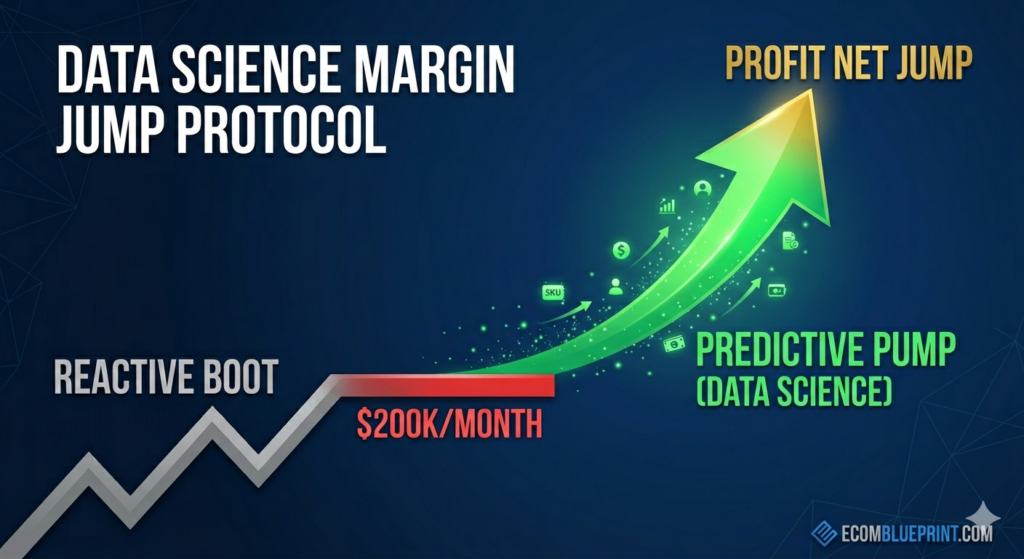
Engineering the Profit Jump: From Reactive to Predictive
At the $200K threshold, your business becomes highly sensitive to micro-variables. Let’s look at how a simple data-driven correction in pricing and returns creates a jump in profit that a smaller brand simply cannot achieve.
Case Study: The High-Leverage Correction (1,000 Units/Month)
| Metric | Month 0 (Baseline) | Month 1 (+$0.80 Price Adj.) | Month 2 (Returns 5% → 3%) |
| Units Sold | 1,000 | 1,000 | 1,000 |
| Unit Price | $50.00 | $50.80 | $50.80 |
| Returns (Rate) | 50 (5%) | 50 (5%) | 30 (3%) |
| Net Revenue | $47,500 | $48,260 | $49,276 |
| Net Profit Gain | – | +$760 | +$1,776 |
[INSIDER NOTE]: The «Free Shipping» Trap: A Real-World Micro-Data Case
Most generic advice says: «Set free shipping at $100 to increase AOV.» At $200K/month, following this blindly is a Margin Drain.
The Case: A brand set free shipping at $100. A customer bought a $120 Pack (Shoes + Transport Bag). The goal was hit, but the data revealed that shipping this specific bulky pack cost $18. This unstudied cost completely eliminated the profit margin of the second product. Without Micro-Data, your «packs» are just a way to lose money faster.
The Result: Instead of offering «Free Shipping» on that bulky shoe pack (which killed the margin), the team analyzed the signals and pivoted to a Strategic Pack: Shoes + Digital Training Guide + Quick-use Wipes. By charging for shipping but increasing perceived value, sales increased by 3% and the net margin remained protected.
Precision is the Standard of the 1%: Leaders in every vertical have already moved from «guessing» to «engineering»:
- L’Oreal doesn’t just «sell cream»; they use data science to map molecular reactions across thousands of skin compositions.
- Rolls Royce treats airplane engines as data nodes to predict maintenance before a single bolt fails.
- Fruition Sciences even applies these algorithms to viticulture, calculating the exact milliliter of water needed for a grape to reach premium quality.
The Takeaway: If a winemaker uses data science to optimize a single grape, why is an e-commerce brand doing $2.4M/year still guessing their shipping thresholds or bundle margins?
***
According to the EMC Statistics Report, the volume of digital data has already exploded past 44 zettabytes—representing roughly 5,200 GB for every person on Earth. In the hyper-competitive U.S. market, this isn’t just a stat; it’s a tipping point. At $200K/month, you are literally drowning in this data. The question is: are you using EMC-level signal extraction to build a competitive moat, or are you just paying for the storage?