
Most businesses view AI and Data as tools for cost-cutting. They implement automation to reduce headcount or speed up basic tasks. However, in high-scale E-commerce, the real power of data isn’t in efficiency—it’s in opportunity detection.
The recent IKEA case study is the most clinical example of how a systems-driven approach can turn a technical bottleneck into a massive revenue engine.
1. The Data Revelation: Finding Gold in the «Failure Rate»
When IKEA introduced «Billy,» their AI customer service bot, they didn’t just look at how many tickets it closed. They looked at what it couldn’t do.
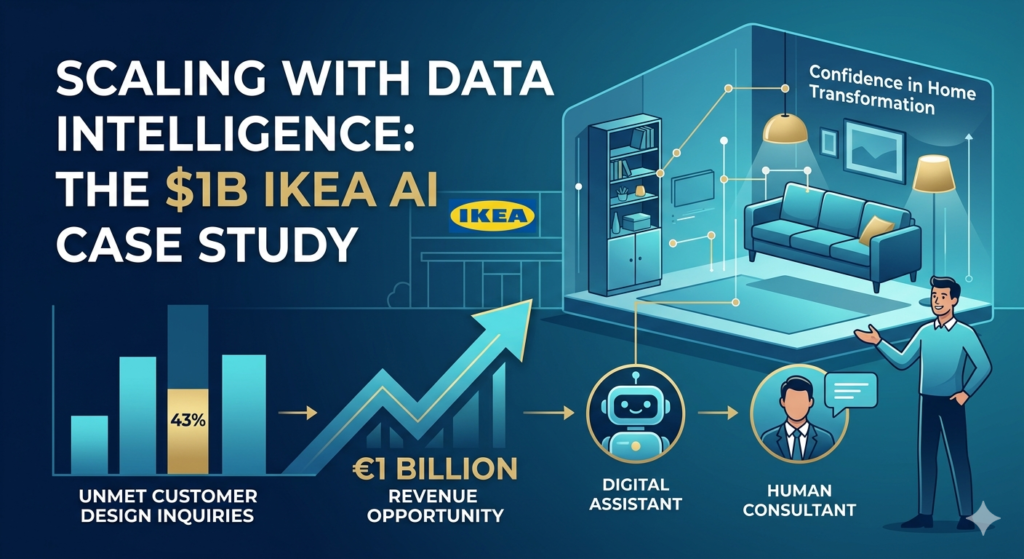
They discovered that 43% of customer inquiries were about complex home interior design—tasks a simple chatbot wasn’t equipped to handle. Instead of seeing this as a technical failure of the AI, they saw it as a massive, underserved market demand.
- The Pivot: Instead of firing staff, they reskilled 8,500 call center employees into remote interior design consultants.
- The Result: This shift, driven by a single data insight, generated €1 billion ($1.1B) in new sales.
2. Scaling with Data Intelligence: Beyond the Linear Growth
This brings us back to a fundamental truth in E-commerce: Scaling is not about winning more; it’s about knowing when to take the «jump» to the next level.
IKEA didn’t scale linearly by adding more chatbots. They identified a Critical Point in their data and leaped to a new service model. This leap required a temporary drop in efficiency (training 8,500 people is a «Profit Valley») to achieve a massive stabilization at a much higher revenue point.
- Data as a Map: Without analyzing those failure points, IKEA would have continued optimizing a chatbot for a problem the customer didn’t want solved.
- Systemic Resilience: By integrating human expertise with data-driven insights, they built a platform that handles complex design high-value sales, not just commodity transactions.
3. The Psychological Bridge: Confidence as a Sales Engine
The true impact of IKEA’s shift wasn’t just «better service»; it was the creation of consumer confidence.
When a customer faces a home renovation, they aren’t just buying furniture; they are looking to change their daily reality. Whether it’s placing a new sofa, rearranging shelving, or choosing the right lighting, these decisions carry emotional weight. By using human consultants to resolve these interior design doubts, IKEA provided the one thing an algorithm cannot: Certainty.
This human proximity ensures the customer feels confident enough to execute the purchase. That confidence is what transforms a «maybe» into a full-house transformation. This isn’t just a sale; it’s a leap in the customer’s lifestyle, and that is where the maximum value resides.
4. The Invisible Truth: It’s Not the AI, It’s the Data
Here is where 99% of people reading this case study miss the point. They think IKEA won because they implemented a sophisticated AI. They are wrong.
This billion-euro breakthrough didn’t happen because of the AI. It happened because of Data Analysis.
- The Data was always there: Those customer doubts and design needs existed long before «Billy» the chatbot. They were hidden in call logs, lost emails, and abandoned carts.
- The AI was just the catalyst: The only thing the AI did was force the company to review «failed» interactions. We are paying attention to AI failures now in a way we never did with human teams before.
- The Silent Asset: Data is a persistent resource. It exists before, during, and after any technology trend.
Without that specific data insight, there are no possible actions. No scaling, no margin improvement, no logistics optimization, and no delivery refinement. You cannot engineer a «jump» to the next level if you are blind to the friction points in your current system.
Data is the only map that shows you where the «Profit Valley» ends and where the next level of stabilization begins.