
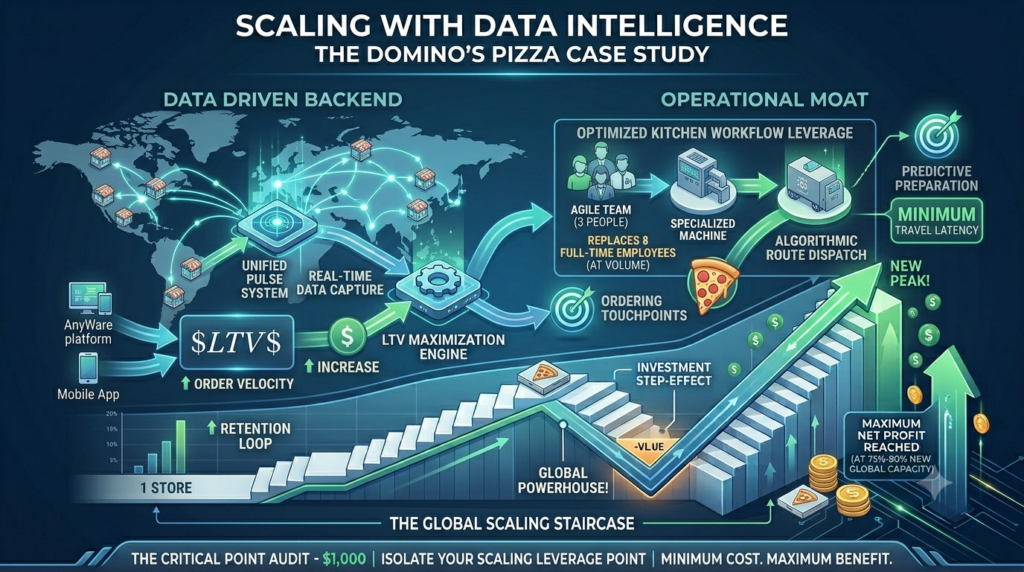
In the corporate history of food delivery and franchise operations, many executives look at Domino’s Pizza as a simple story of fast food and aggressive pricing. That is a massive strategic blind spot. Domino’s did not scale into a global powerhouse by merely modifying its crust recipe; it transformed its entire organization into an elite tech company that happens to deliver pizza.
By restructuring its legacy setup into a data-driven ecosystem, Domino’s managed to break the linear dependency between transaction growth and operational overhead, mastering the mechanics of the Scaling Staircase.
1. The Technological Turning Point: Rebuilding the Core Backend
During its initial growth phase, Domino’s operated on highly fragmented legacy software. Each franchise location functioned as an independent operational silo, running individual point-of-sale (POS) setups with zero centralized tracking.
To scale past this phase, corporate leadership initiated an infrastructure shift. They developed a unified, proprietary POS software architecture known as Domino’s PULSE.
[ FRANCHISE SILOS ] ──► [ UNIFIED PULSE SYSTEM ] ──► [ CENTRALIZED ARCHITECTURE ]
This structural realignment required heavy up-front capital allocation and temporarily squeezed global operational margins. However, once this unified backend reached 75% to 80% working capacity, it unlocked incredible efficiency. The unified infrastructure allowed corporate to capture raw transaction data from every single location in real time, transforming the entire company into a synchronized data asset.
2. Retention and the Frictionless Front-End Engine
Once the core backend was stabilized, Domino’s focused its data intelligence on front-end transaction velocity. They launched the AnyWare platform, which decoupled order placement from traditional channels. Customers could suddenly order pizza via text, smart TVs, smartwatches, voice assistants, or even by simply tweeting a pizza emoji.
This strategic move was not a marketing gimmick; it was an optimization model engineered to eliminate purchase latency.
- The AnyWare Ecosystem: By integrating all front-end ordering touchpoints directly into the centralized PULSE engine, they drove massive customer acquisition.
- The Retention Loop: Once a customer created a profile and saved their «Easy Order» preferences, acquisition costs (CAC) dropped to zero for subsequent orders.
- Predictable High-Margin Revenue: At scale, these repeat buyers became a highly stable, recurring source of profit. The database itself turned into a massive business asset, insulating the company from fluctuating third-party platform costs.
3. Team Leverage and Process Optimization: The 3-Person Workflow
True scaling requires breaking linear dependencies. In a traditional kitchen, doubling order volume usually requires doubling kitchen staff, which instantly eats away at your net margins. Domino’s used data intelligence to alter this operational math.
By combining real-time order forecasting, automated tracking machinery, and an optimized physical layout, they engineered highly leveraged workflows:
The Scale Effect: In a highly optimized Domino’s kitchen, a lean team of just three people—one managing the automated dough-stretching station, one running the centralized topping line, and one supervising the automated oven dispatch—can efficiently execute the volume of orders that previously required a staff of eight full-time employees.
This level of leverage is impossible at low volumes. It is only when transaction density crosses a high threshold that the advanced machinery and automated routing software pay off, immediately converting high volumes into pure bottom-line efficiency.
4. Identifying Your Strategic Leverage Point (The Domino’s Moat)
To achieve this level of structural efficiency, you must run a deep diagnostic on your organization to isolate your Strategic Leverage Point—the unique operational node that unlocks exponential scaling.
For Domino’s, this leverage point was the Tracker and Route Optimization Engine.
┌─────────────────────────────┐     ┌─────────────────────────────┐     ┌─────────────────────────────┐
│ Real-Time Order Ingestion   │ ──► │ Automated Kitchen Display   │ ───► │  Algorithmic Route Dispatch │
│   (Predictive Preparation)  │     │   (Oven Transit Matrix)     │     │   (Minimum Travel Latency)  │
└─────────────────────────────┘     └─────────────────────────────┘     └─────────────────────────────┘
They did not treat delivery as an external cost; they engineered it as a core software component. The routing software automatically bundles orders, predicts cooking times down to the second, and maps the most efficient physical path for drivers. This algorithmic infrastructure allows a franchise to double its nightly delivery output while reducing manual coordinating hours and driver downtime.
5. Horizontal and International Scaling Symmetry
When Domino’s decides to enter a net-new geographical territory, they do not reinvent their core operating workflows. They utilize a highly disciplined Symmetric Expansion model.
| Scaling Dimension | Symmetric Expansion (The Domino’s Way) | Asymmetric Error (What to Avoid) |
| Backend Infrastructure | Deploys localized storefronts on top of the central global ERP. | Building separate, siloed software for every country. |
| Supply Chain Alignment | Uses centralized regional dough manufacturing hubs to feed stores. | Allowing individual stores to source raw materials manually. |
| Data Ingest Layer | Flawlessly translates multi-currency sales data into central corporate dashboards. | Creating manual accounting workflows to reconcile international sales. |
By keeping the backend completely standardized while localizing the front-end menu items and currencies, Domino’s ensures that cross-border expansion drives high-margin revenue without introducing fatal administrative friction.
6. Embracing Transactional Velocity
The core lesson of the Domino’s Pizza case study is that scaling is moving. They did not build a static franchise; they built a high-velocity transactional engine.
By relentlessly optimizing delivery times, eliminating ordering friction, and automating the physical preparation layout, their massive transaction density naturally revealed entirely new monetization lanes. When your systems are structured to manage high-velocity data flows, the operational drift will always uncover hidden assets within your organization. Build the engine, protect the backend, isolate your leverage point, and drive your operational infrastructure toward its next global peak.