
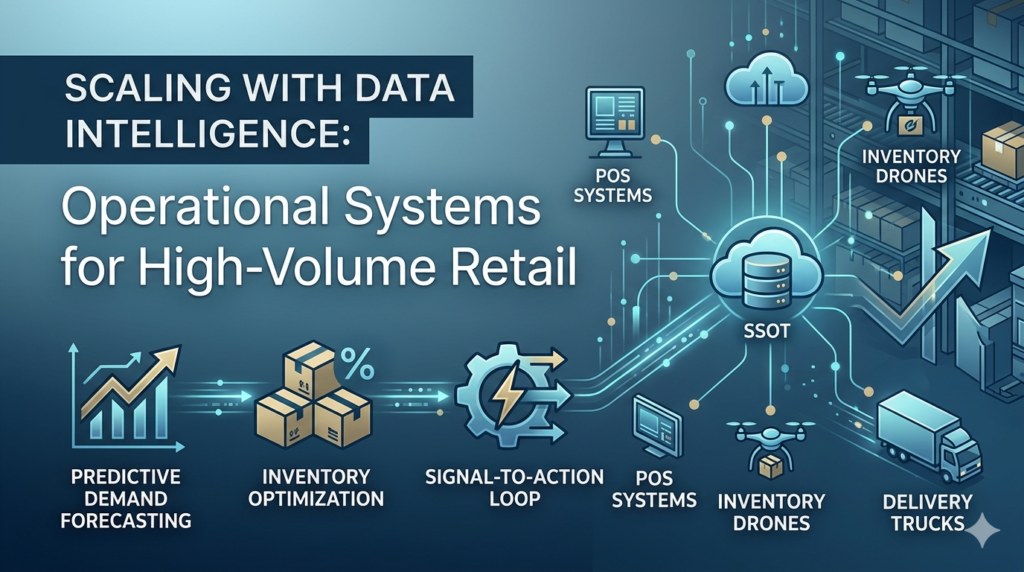
In high-volume businesses, scaling is not a linear sales process but a systems transition. Success depends on the ability to evolve from intuitive decision-making toward the use of Data Intelligence, allowing the operational infrastructure to support growth without collapsing net margins.
1. Key Data-Driven Strategies for Scaling
To maintain efficiency during rapid expansion, integrating real-time data flows is essential:
- Predictive Demand Forecasting: Anticipating demand through historical data analysis to avoid stockouts or overstocking costs.
- Dynamic Pricing and Promotions: Using market data to adjust prices dynamically, protecting margins against competition.
- Inventory Optimization: Identifying slow-moving products and optimizing reorder points to maximize cash flow.
2. Operationalizing Data for High-Volume Stores
Scaling requires the organization to move past retrospective reporting and adopt an immediate response mindset:
- Centralized Data Infrastructure: Implementing a «Single Source of Truth» (SSOT) that unifies POS, inventory, and logistics. Without centralized infrastructure, data becomes fragmented and decision-making slows down.
- The «Signal-to-Action» Loop: Creating a framework where data capture triggers automatic actions (such as replenishment) within minutes, eliminating manual bottlenecks.
3. Benefits of Data Intelligence: Efficiency and Risk Mitigation
Implementing data intelligence into operations not only improves revenue but also shields the business against the inherent risks of accelerated growth:
- Operational Efficiency: Workforce optimization based on customer traffic prediction, reducing unnecessary spending during low-impact hours.
- Risk Mitigation: Drastically reducing the risk of excessive stock, preserving the liquidity necessary to reinvest in expansion.
- Automated Decision-Making: Advanced analytics tools allow the system to self-adjust, supporting agile scaling and reducing dependency on micro-management.
The Data Analysis Imperative
99% of retail scaling failures occur because the data foundation is not prepared for the operational load. Without rigorous information analysis, there is no viable scaling strategy. Data intelligence is the map that allows you to identify the critical point of failure before it compromises profitability.
The Weak Link: Identifying the Bottleneck
Every retail system has a weak link. It is the point where we maximize activity, yet scaling comes to a halt. This bottleneck is not always obvious; it could reside in inventory data latency or a logistics chain unable to react to demand spikes. To scale effectively, we must foresee the resources and processes required to leap to the next structural point. Data allows us to anticipate these needs, ensuring a transition without technical stumbles or setbacks.