
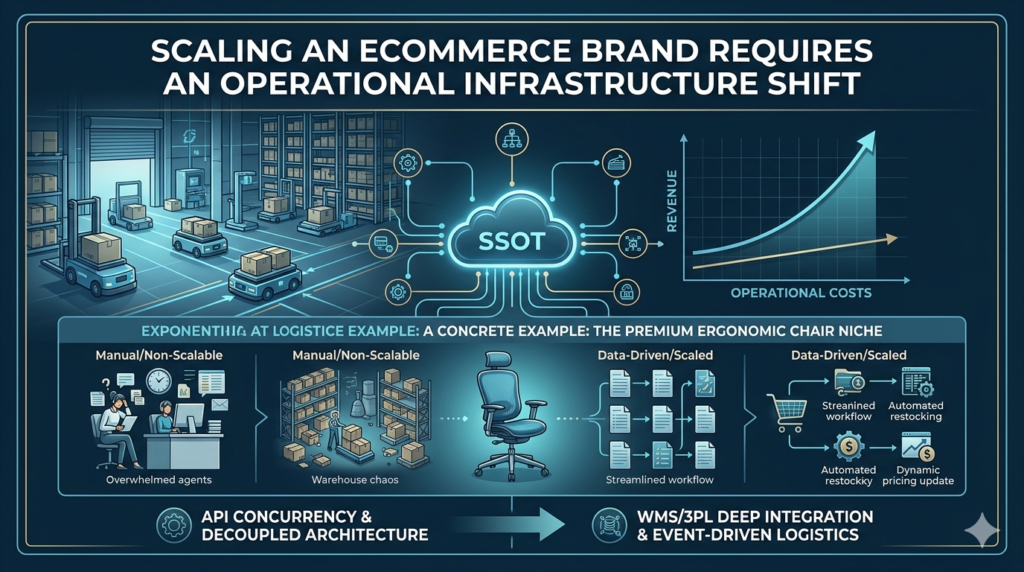
In high-volume e-commerce, the word «scaling» is frequently weaponized by marketing agencies promising exponential revenue spikes. However, true scaling is not a customer acquisition milestone; it is an operational and systems transition.
Growth increases revenue by adding resources at a parallel rate, but scaling is the structural capability to increase transaction volume exponentially while costs grow linearly. To achieve this, brands must move past the optimization of front-end funnels and execute a profound operational infrastructure shift.
1. Centralized Data Infrastructure: Building the SSOT
The first phase of this infrastructure shift requires dismantling data silos. In unscaled brands, information lives isolated within Shopify, ERPs, customer support platforms, and third-party logistics (3PL) databases.
Scaling demands the implementation of a Single Source of Truth (SSOT) using unified data lakes (such as Azure or Databricks). This centralized infrastructure unifies all operational data points into a single environment in real time. Without a technical foundation that ensures data integrity, cross-departmental alignment collapses, making precise scaling impossible.
2. A Concrete Example: The Premium Ergonomic Chair Niche
To understand how this infrastructure shift operates under pressure, consider a vertical e-commerce brand specializing in Premium Ergonomic Office Chairs transitioning from $2M to $15M in annual revenue:
- The Non-Scalable Approach (Growth-Driven): To handle order spikes, the brand hires more customer support agents, rents extra unoptimized warehouse space, and manually reviews stock levels every Friday. Operational costs surge alongside revenue. When a major sales event occurs, the system breaks—customer service gets backlogged, manual reorders arrive late, and stockouts destroy net margins.
- The Scalable Approach (Infrastructure Shift): The brand connects its entire ecosystem to an SSOT.
- The Predictive Loop: The data layer monitors conversion velocity and calculates that a 15% mid-week spike in a specific configuration (e.g., Black Mesh with Lumbar Support) will cause a stockout in exactly 10 days.
- The Automated Action: The system instantly triggers a reorder query to the manufacturer and updates the dynamic pricing matrix to preserve the remaining margin—all without human intervention.
The business processes 7x the transaction volume, but operational costs only increase by 1.5x.
3. API Concurrency and Decoupled Architecture
When an e-commerce brand scales, the sheer volume of simultaneous API requests (checkout webhooks, inventory syncs, ERP updates) can bottleneck traditional monolithic systems. A true infrastructure shift involves moving toward a decoupled or headless architecture.
By separating the front-end from the back-end data processing layers and using asynchronous message brokers (like RabbitMQ or AWS SQS), the system can queue and process thousands of orders per minute. This ensures that a massive surge in front-end traffic never crashes the fulfillment, inventory, or billing systems.
4. WMS/3PL Deep Integration and Event-Driven Logistics
Scaling means your physical supply chain must match your digital velocity. A legacy infrastructure relies on batch-processing (e.g., syncing orders to the warehouse once a day). Scaling requires an event-driven infrastructure where the Warehouse Management System (WMS) or 3PL network is deeply integrated via real-time APIs.
Every single event—an item packed, a carrier assigned, a return received—must instantly feed back into the central data infrastructure. This level of automated integration reduces order-to-ship latency, eliminates manual data entry, and allows the brand to distribute inventory across multiple regional warehouses efficiently.
Managing the Roadmap: The Annual Perspective
Executing this infrastructure shift allows brands to abandon reactive management and focus on clear, sequential milestones necessary for conscious scaling. It eliminates operational surprises by giving teams the data required to work on infrastructure demands well in advance. These optimization projects are engineered with an annual perspective, providing high-volume e-commerce operations with excellent structure, clear forecasting, and long-term organizational stability.