
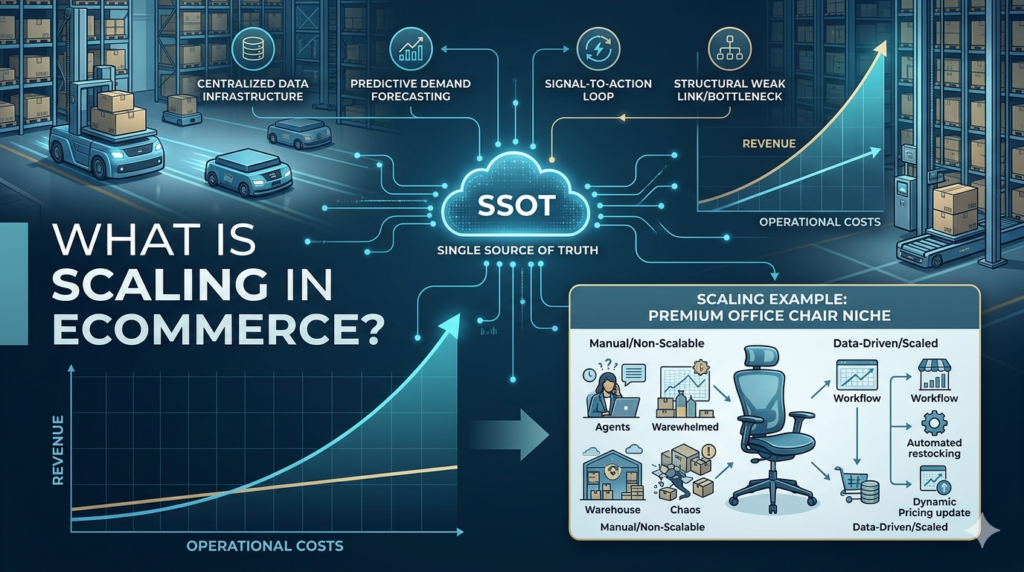
In the digital retail sector, scaling is frequently confused with simple growth. While growth implies increasing revenue by adding resources at a parallel rate, scaling is the ability to increase revenue exponentially while costs grow linearly. For high-volume e-commerce businesses, scaling is not a marketing milestone; it is an operational and systems transition. It means building an infrastructure capable of handling ten times the transaction volume without requiring ten times the manual labor or collapsing net margins.
1. Centralized Data Infrastructure (SSOT)
The foundation of any serious scaling project is the creation of a Single Source of Truth (SSOT). This involves the technical unification of fragmented information from POS systems, inventory databases, and logistics platforms into a single environment (such as Azure or Databricks). Without this centralized infrastructure, data remains siloed, making agile scaling impossible.
2. Strategic Data Implementation for Scaling
Once the infrastructure is in place, scaling focuses on integrating real-time data flows to execute core growth strategies:
- Predictive Demand Forecasting: Analyzing historical data and seasonal trends to anticipate demand, thereby preventing stockouts and overstocking during rapid volume spikes.
- Dynamic Pricing: Implementing automated price adjustments based on market demand and competitor activity to protect net margins at scale.
- Inventory Optimization: Using advanced analytics to identify slow-moving SKUs and set optimal reorder points, maximizing cash flow.
3. Operationalizing the «Signal-to-Action» Loop
A key objective of scaling is shifting from retrospective reporting to immediate response. True scaling designs a framework where data capture (signals) triggers automatic actions (triggers)—such as automated replenishment or logistics adjustments—within minutes, eliminating manual bottlenecks.
4. Identifying the Structural Weak Link
Scaling inherently tests the stress limits of an organization. A data-driven approach must locate the «critical point» or the bottleneck where activity is maximized but growth stops. Whether it is inventory latency or logistical incapacity, data allows the business to foresee the resources needed to leap to the next structural level. This ensures a transition without technical stumbles or unexpected setbacks.
Scaling Benefits: Efficiency and Risk Mitigation
- Operational Efficiency: Optimizing workforce hours and warehouse processes based on predicted customer demand.
- Risk Mitigation: Drastically reducing excessive stock levels to preserve the liquidity needed for expansion.
- Automated Decision-Making: Creating self-adjusting systems that support agile scaling and reduce dependency on manual micro-management.
A Concrete Example of Scaling: The Premium Ergonomic Office Chair Niche
To see the difference between simple growth and system scaling, let’s look at a vertical e-commerce brand specializing in Premium Ergonomic Office Chairs making the leap from $2M to $15M in annual revenue:
- The Growth Approach (Non-Scalable): To handle more orders, the company hires five more customer support agents, rents a second unoptimized warehouse, and manually reviews inventory levels every Friday. Costs grow at the same rate as revenue. When a massive demand spike hits, the system collapses: support gets backlogged, manual reorders are late, and stockouts destroy net margins.
- The Scaling Approach (Data-Driven): Instead of adding manual labor, the company implements Data Intelligence. They build an SSOT unifiying Shopify, ERP, and their 3PL logistics provider.
- The Predictive Loop: The system analyzes conversion velocities and detects that whenever a specific configuration (e.g., Black Mesh with Lumbar Support) spikes by 15% mid-week, a stockout will occur in 10 days.
- The Signal-to-Action: The system automatically triggers a reorder query to the manufacturer and updates the dynamic pricing matrix to protect the remaining margin, all without human intervention.
The Result: The business increases its transaction volume by 7x, but operational costs only rise by 1.5x. The infrastructure absorbs the volume smoothly because the data foundation handles the complexity.