
Once you have audited your internal infrastructure and visually mapped out how your systems handle operational stress, you reach a defining crossroads in your scaling roadmap. Your core foundation is stable, and your workflows are aligned. Now, you must choose the vector of expansion that will drive your next wave of growth.
Expanding into new verticals is one of the most powerful moves an organization can execute, but it introduces deep strategic complexity. This decision is not just a product launch; it is a structural choice between two fundamentally opposing architectural models.
Choosing between these paths is one of the most critical decisions a company will make during its scaling evolution.
1. The Natural (Symmetric) Vertical Expansion
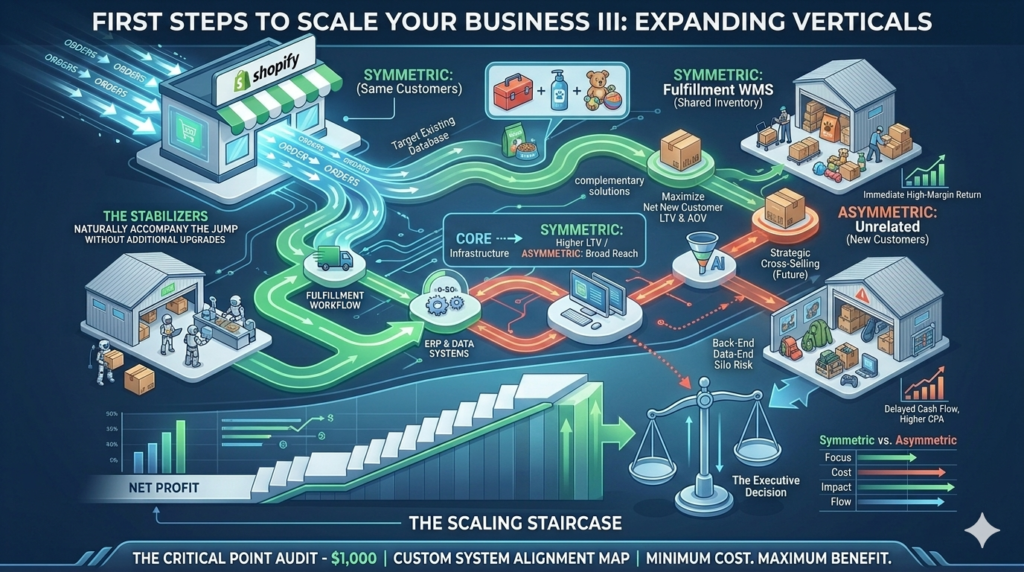
The most common approach to scaling is a symmetric expansion—introducing a natural, adjacent vertical designed specifically to appeal to your existing database.
The primary goal here is to drastically increase Customer Lifetime Value (LTV) and Average Order Value (AOV) by offering highly complementary solutions that your current buyers already want and need.
- The Ecosystem Fit: For a symmetric expansion to work without breaking your business, the new products must lock seamlessly into your existing infrastructure. They must utilize the exact same data layers, the same warehouse management systems (WMS), and the same front-end marketing structures without creating administrative misalignment.
- The Pet eCommerce Example: Consider a high-volume brand built entirely around premium pet food.
- The Expansion: The brand naturally expands into pet toys and specialized anti-allergy grooming products.
- The Synergy: The acquisition infrastructure remains identical. The customer who buys premium kibble is already pre-qualified to buy specialized shampoo. The fulfillment workflow remains completely unbothered—the items are packed, shipped, and tracked using the exact same systems, driving high-margin revenue with minimal additional operational friction.
2. The Unrelated (Asymmetric) Vertical Expansion
The alternative strategy is to deliberately deploy an asymmetric expansion—launching a completely unrelated vertical designed for an entirely different target audience. This path bypasses your current database completely to capture an entirely new customer segment.
- The Strategic Challenge: This is an entirely different operational animal. By entering a vertical that your current customers do not use, you are intentionally choosing to build a brand-new front-end customer acquisition engine from scratch. Your existing ad copy strategies, brand messaging, and audience pools cannot be recycled.
- The Structural Stress Test: While your front-end marketing must be built anew, your back-end operational engine faces a massive test. The new vertical must still rely on your core systems—your accounting software, database servers, and main logistics partnerships—to maintain linear cost growth. If an asymmetric vertical requires you to rent separate warehouses or hire completely separate logistics teams, you aren’t scaling an ecosystem; you are simply managing two separate businesses, losing all structural leverage.
       ┌──► SYMMETRIC: Same Customers ──► Higher LTV ───► Zero Friction
CORE ──┤
       └──► ASYMMETRIC: New Customers ──► Broad Reach ──► High Front-End Cost
3. The Executive Decision: Extraction vs. Acquisition
When designing your expansion project, leadership must decide which asset to leverage first to balance the financial curve of the scaling staircase:
| Metric / Dimension | Symmetric Expansion (Adjacent) | Asymmetric Expansion (Unrelated) |
| Primary Focus | Maximizing existing Customer LTV. | Net-new Customer Acquisition. |
| Front-End Cost | Minimum (Uses existing ad accounts & data). | Maximum (Requires separate funnels & testing). |
| Back-End Impact | Low friction; uses current layouts and workflows. | High risk of data silo creation or fulfillment friction. |
| Cash Flow Profile | Immediate high-margin return from warm traffic. | Delayed return; high initial testing investment. |
Conclusion: Aligning the Expansion to the Roadmap
There is no single correct path, but there is a correct sequence. If your visual systems map shows that your warehouse or customer service workflows are operating at a tight 75% capacity, a symmetric expansion is often the safest path to extract maximum net profit with zero added friction.
However, if your operational engine is deeply automated and hungry for raw volume, launching an asymmetric vertical can unlock entirely new market shares. The key to successful scaling is ensuring that whichever path you choose, your back-end infrastructure is fully engineered to absorb the expansion smoothly, ensuring that your next growth tier remains stable and highly profitable.