
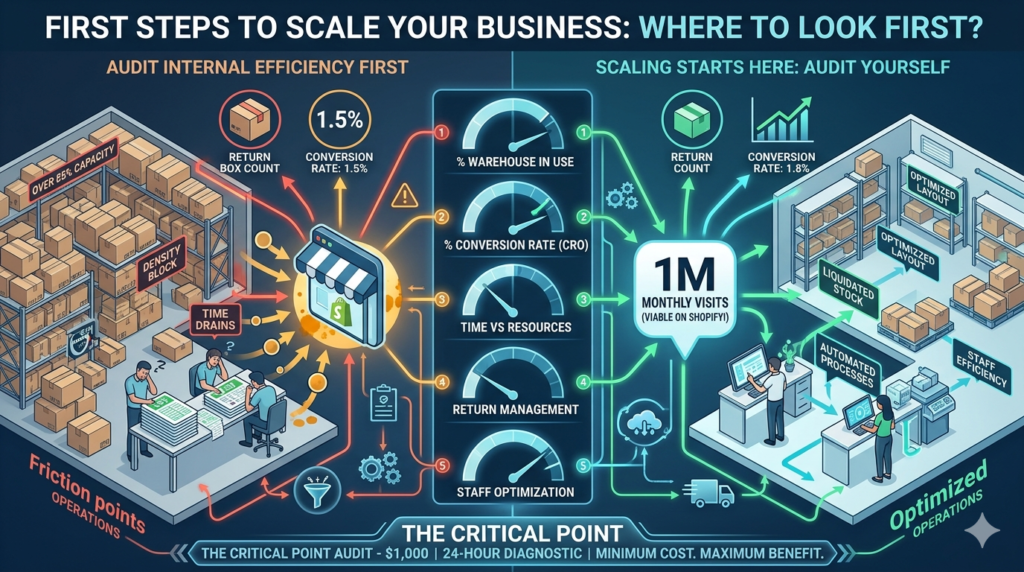
When a Shopify eCommerce store reaches massive volume —yes, it is perfectly viable and possible to handle one million monthly visits on Shopify thanks to its cloud infrastructure and decoupled architecture— the knee-jerk reaction for most managers is to inject more budget into customer acquisition.
However, as we have analyzed in previous posts, true scaling is not about increasing revenue linearly while growing costs at the exact same pace. Scaling means preparing your infrastructure to absorb that million visits efficiently, multiplying net profit while keeping operational costs tightly controlled.
If you are ready to make the leap, the first step is not external (marketing); it is a deep audit of your internal operational efficiency. This is exactly where you need to look first to find minimum-or-zero-cost, maximum-benefit levers:
1. Structural Capacity: % of Warehouse in Use
Before pushing more inventory into your system, measure your physical saturation. A warehouse operating above 85% capacity suffers from «density block»: operators take twice as long to locate items, picking errors double, and cash flow freezes in slow-moving SKUs.
- Zero-cost action: Liquidate obsolete stock to free up space and reorganize the warehouse layout, prioritizing products with the highest sales velocity (purchase frequency).
2. Optimizing Existing Traffic: % Conversion Rate (CRO)
If you already possess a high volume of traffic, improving your conversion rate by just a few tenths of a percent delivers a massive impact on your net margin without investing a single additional cent in ads.
- Minimum-cost action: Analyze your checkout funnel. Eliminate unnecessary fields in forms, optimize mobile loading speeds, and ensure local payment methods are active. Moving from a 1.5% to a 1.8% conversion rate with one million visits radically transforms business profitability.
3. Time vs. Resources Audit of Internal Work Systems
Measure how many hours your team spends on mechanical, repetitive tasks. If processing the day’s orders requires your staff to manually download a CSV from Shopify, edit it in Excel, and re-upload it to a third-party logistics (3PL) platform, your workflow system is on the verge of collapse.
- Minimum-cost action: Map out daily operational bottlenecks. Automate data flows using native integrations or process automation tools to free up staff time, redirecting human capital toward high-value tasks.
4. The Margin Drain: Return Management
In high-volume eCommerce, poorly managed returns are a silent drain on profits. Every return triggers reverse logistics costs, quality inspection time, re-labeling overheads, and product devaluation.
- Zero-cost action: Deep dive into return data. If a specific product is systematically returned due to sizing or quality issues, update the product page with ultra-precise descriptions, actual product videos, or interactive sizing charts. Preventing a return at the source costs nothing and safeguards the operation’s net margin.
5. Process Automation and Staff Optimization
Scaling successfully means your current team must be capable of absorbing double the order volume without immediately doubling headcount.
- Minimum-cost action: Implement automated customer support systems for order status inquiries and automated workflows for stockouts. Staff should only step in when the system detects a genuine exception, rather than touching the standard operational flow.
Conclusion: Your Initial Scaling Radiography
This internal analysis will grant you a real, highly reliable baseline view of your business health. It allows you to pinpoint exactly which optimizations to deploy immediately to fortify the company’s foundations. By correcting these operational friction points in advance, you guarantee that when traffic and sales continue to multiply, your structure will respond with absolute precision, control, and maximum profitability.