
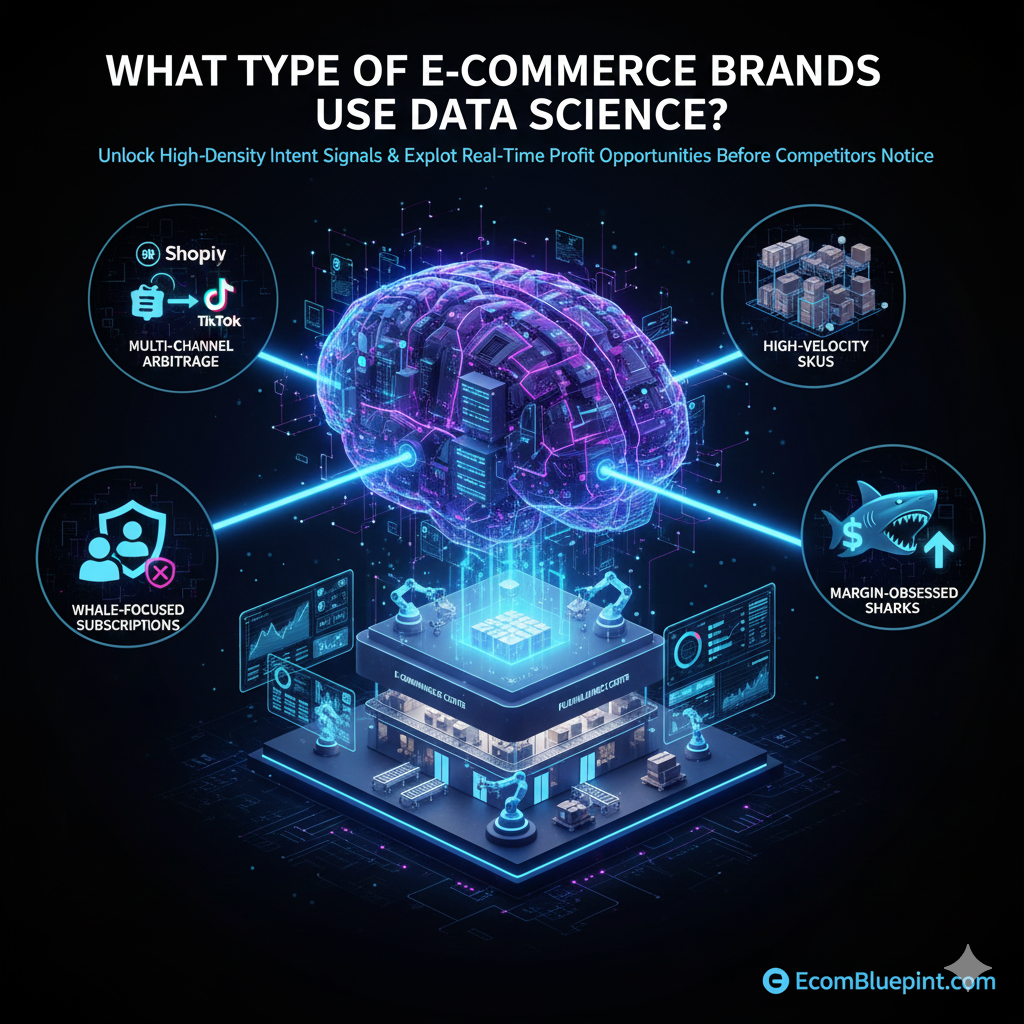
Data science in e-commerce is not a tool for every store; it is the competitive advantage for brands that have moved past «survival mode» and into «scaling architecture.» High-performance brands use data science to transition from reactive marketing to predictive operations, systematically eliminating margin erosion and optimizing inventory liquidity before it becomes a bottleneck.
The Threshold: When «Intuition» Fails
Most e-commerce businesses are built on intuition. Founders make decisions based on what they think their customers want. This works until a certain threshold—usually when the volume of SKUs, customer data, and ad spend makes human processing impossible.
The brands that use data science are not defined by their revenue, but by their complexity. They are the brands that realize their biggest enemy isn’t the competition—it’s their own operational chaos.
1. The Multi-Channel Arbitrageurs
These brands operate across multiple platforms (Shopify, Amazon, TikTok Shop). They use data science to solve the Attribution Nightmare.
- They don’t guess which channel is profitable.
- They use machine learning models to identify exactly where the marginal dollar of profit is generated, automatically reallocating budget in real-time.
2. The High-Velocity SKU Operators
Brands with massive catalogs (fashion, electronics, cosmetics) face the «Inventory Death Trap.»
- They use data science to predict demand with surgical precision.
- Instead of keeping massive safety stock, they leverage micro-data to identify which variations (color, size, bundle) are about to peak and which are about to turn into dead weight.
3. The «Whale-Focused» Subscription Brands
For these brands, Churn is the ultimate killer. * They use data science to score every customer on a «Propensity to Churn» model.
- Before a customer cancels, the system automatically triggers a personalized intervention (a specific offer or outreach) based on their historical behavior. They don’t wait for the customer to leave; they predict the exit and prevent it.
4. The Margin-Obsessed «Sharks»
The most advanced brands use data science to monitor Margin Erosion in real-time.
- They don’t just track Revenue; they track Net Contribution Margin per SKU.
- If an ad campaign shows a high ROAS but a low net margin (due to returns or shipping costs), the data model kills the campaign automatically. These brands prioritize net profit over gross volume every single time.
Why You Don’t Need Millions to Start
There is a misconception that data science is only for the «Fortune 500.» In reality, the brands that benefit most are the «Agile Giants»: mid-sized e-commerce companies that are too big to manage manually but too agile to rely on the slow, bureaucratic systems of traditional retail.
They use data science as a force multiplier. It allows a 10-person team to run operations with the efficiency of a 100-person company.
The Defining Characteristic: The Data-to-Action Cycle
If you look at the brands using data science, you’ll notice one thing: they don’t report; they execute.
Their systems are not meant to generate pretty PDFs for board meetings. Their systems are designed to trigger automated actions:
- Changing prices based on competitor stock.
- Pausing underperforming ads.
- Reordering stock only when the probability of sale hits a specific threshold.