
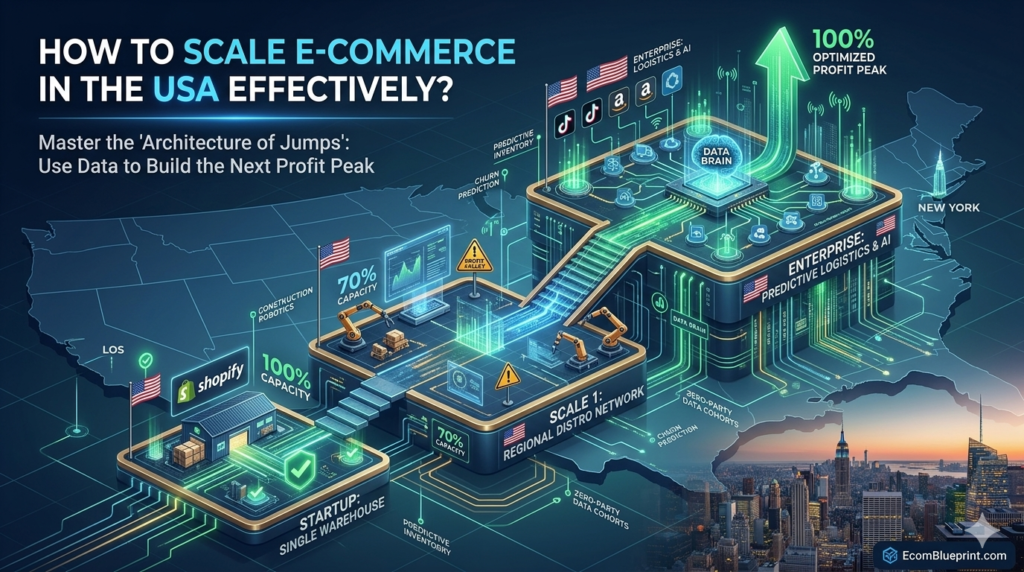
Scaling a US e-commerce brand is not a linear climb; it is a series of architectural leaps driven by data-driven insights. To reach the next «profit peak,» brands must invest in new infrastructure—software, talent, or logistics—which temporarily lowers net margins until the new structure reaches 100% capacity. Effective scaling requires using data science to identify the exact requirements needed to bridge the gap between your current peak and the next level of operational efficiency.
The Myth of Linear Growth: The «Jump» Architecture
Most founders expect their profit to grow in direct proportion to their sales. In the hyper-competitive US market, this is a dangerous illusion.
Growth happens in picos (peaks). You reach a point where your current architecture—your team, your Shopify setup, your 3PL—is at 100% efficiency. You are profitable, but you are capped. To grow, you must make a «jump.» This means investing in:
- Advanced Infrastructure: Upgrading to enterprise-level data stacks.
- Specialized Talent: Hiring the «Sharks» who understand the US tax and logistics landscape.
- Logistics Expansion: Moving from one warehouse to a distributed regional network.
The Result: Your efficiency drops to 70%. Your net profit decreases because your overhead has spiked. You are in the «valley» between peaks. You won’t see your real profit improve again until you optimize this new structure back to 100%. Scaling is about managing these descents to reach the next, higher peak.
Data as the Compass: Identifying the Next Peak
In the US, you cannot guess where the next peak is. Information is the only fuel for this journey, and that information only comes from Rigorous Data Analysis.
To scale effectively, your data must answer three critical questions:
- What is the «Capacity Ceiling» of my current ad spend? When does the CAC (Customer Acquisition Cost) start to cannibalize the margin?
- What is the infrastructure bottleneck? Is it my customer service response time or my last-mile delivery cost in the Midwest?
- When is the optimal time to «Jump»? Data science tells you exactly when your current ROI is starting to plateu, signaling that it’s time to reinvest in the next level of your architecture.
Regional Arbitrage: Winning the US Map
The USA is a continent, not a country. Data allows you to identify Micro-Opportunities by state or even by zip code.
- The Strategy: Instead of a «Nationwide» blast, use data to find where your «Whale» customers are concentrated.
- The Execution: If your data shows a high concentration of high-LTV customers in Florida, you don’t just send ads there; you move inventory there. This «Physical Data» move slashes shipping times and raises your profit peak by reducing operational friction.
The Objective-Driven Framework
Scaling in the US requires shifting from «more sales» to «specific objectives.»
- Objective A: Optimize the current structure to hit 100% efficiency (Maximize current profit).
- Objective B: Identify and fund the «Jump» (Invest in the next architecture).
- Objective C: Navigate the «Profit Valley» (Stabilize the new structure as fast as possible).
Conclusion: If you try to scale a US e-commerce without a data-driven map, you will get lost in the «Profit Valley» and never reach the next peak. Information isn’t just power; it’s the bridge between the structure you have and the giant you want to become.