
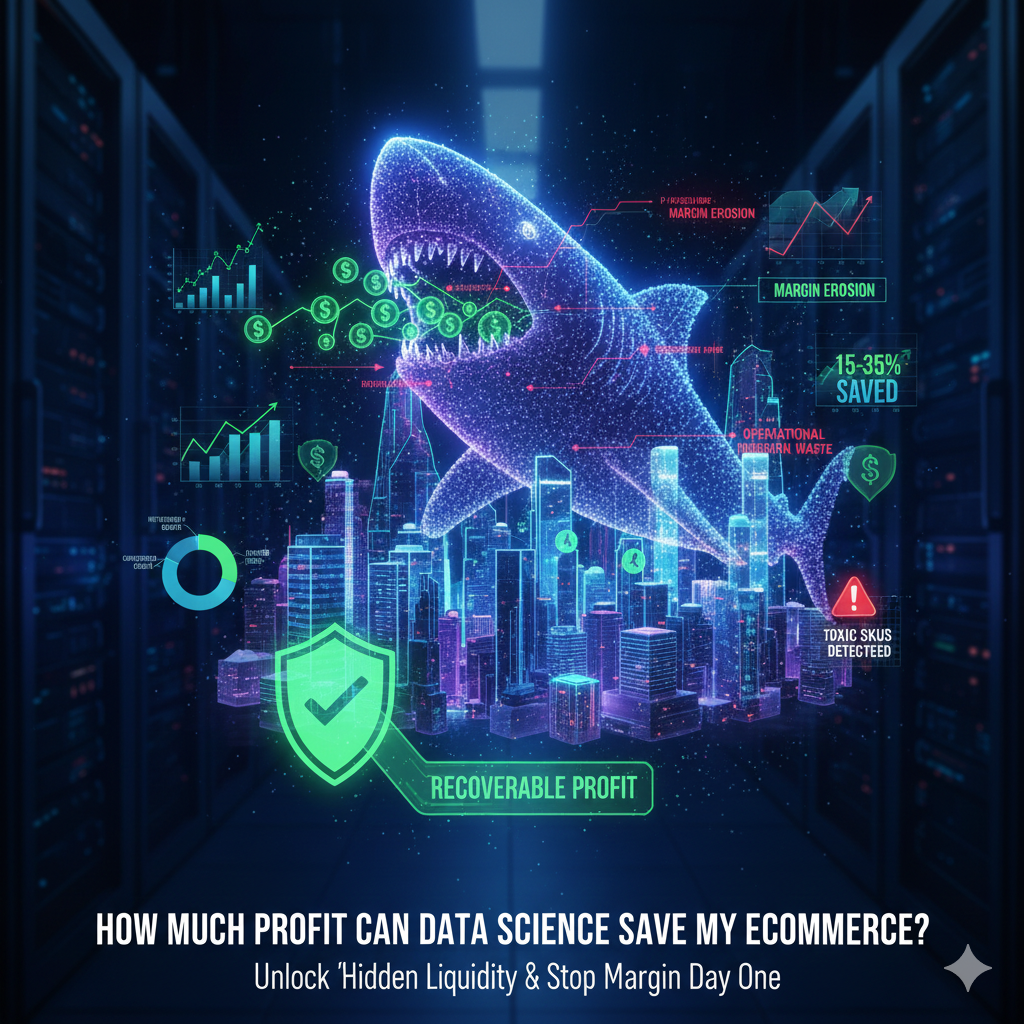
Data science can save an e-commerce business between 15% and 35% of its annual net profit by eliminating operational waste and structural margin erosion. This is achieved through the automated identification of toxic SKUs, the reduction of inventory carrying costs, and the optimization of ad spend attribution. Implementing high-precision data models transforms hidden losses into recoverable liquidity from the first month of execution.
Stopping the Silent Bleeding: Where Your Margin Disappears
Most e-commerce founders focus exclusively on scaling sales, unaware that their current structure is designed to lose money silently. In this context, ecomm-data is not used for «viewing charts»—it is used to stop what we call Margin Erosion.
If you are not using advanced data models, you are paying an «ignorance tax» on every single order. This tax manifests in products that show a positive ROAS on Facebook but, after analyzing returns, stockouts, and customer support overhead, actually result in a net loss. Data science identifies these leakage points, allowing you to cut ad spend on these items immediately, saving thousands of dollars that were previously dismissed as the «cost of doing business.»
Inventory Arbitrage: Saving Capital from Dead Shelves
One of the most significant savings generated by data analytics for ecommerce is found in the warehouse. Money tied up in stagnant stock is money losing value every day.
- Reduction of Carrying Costs: Maintaining unnecessary stock typically costs between 20% and 30% of the inventory value annually. Data science predicts exactly when each unit will sell, allowing you to operate with leaner inventory without the risk of stockouts. This releases massive liquidity that can be reinvested into aggressive acquisition.
- Eliminating Overstock Liquidation: Many stores end up fire-selling products at 50% discounts just to clear space. A preventive data model stops you from buying that excess in the first place, saving the full margin of those sales that would otherwise have been sacrificed.
Ad Spend Recovery and High-Precision Attribution
Marketing is often the largest and most inefficient cost center. The use of advanced ecomm-data allows for what we call «Investment Recovery.»
It is not about spending less; it is about stopping spend on what does not work. Standard attribution models in Shopify or Google Ads often overestimate the success of certain campaigns. By crossing click data with real net margin (CM3) and customer retention data, data science reveals which campaigns are attracting «one-time» customers (who only hunt for discounts) and which are building your company’s Lifetime Value (LTV). Adjusting this flow can save up to 40% of your monthly marketing budget, redirecting it only toward what generates real profit.
Learning from the Sharks: The Efficiency Gap
If we look at the «E-commerce Sharks» generating hundreds of millions in revenue, their biggest secret is not marketing—it is operational efficiency. They do not allow a product to lose money for more than 48 hours. Their data science systems trigger automatic alerts the moment an SKU shows signs of margin erosion.
From day one, your e-commerce can utilize this same logic. You do not need million-dollar revenues to stop losing money like a large corporation. Savings do not come from cutting necessary expenses, but from eliminating the mathematical inefficiencies that your competitors ignore. In today’s market, profit is not just created by selling; it is created by recovering every cent that operational chaos tries to take away.